Free software is a kind of software, which can be used, copied, modified and shared for non-commercial purposes by anyone with no fees or purchases. Examples of free software that I have used are for example GIMP image editor and Openoffice text editor. These are quite quality software freely downloadable from the web. Both of them are also open source softwares.
Sunday, December 5, 2010
Ethics and Law in New Media homework - Week 11
Free software is a kind of software, which can be used, copied, modified and shared for non-commercial purposes by anyone with no fees or purchases. Examples of free software that I have used are for example GIMP image editor and Openoffice text editor. These are quite quality software freely downloadable from the web. Both of them are also open source softwares.
Sunday, November 28, 2010
Ethics and Law in New Media homework - Week 10
Monday, November 15, 2010
Ethics and Law in New Media - Week 8
While going through different studies and materials about Anglo-American and Continental European school of IP, I found one research which caught my attention. It was a paper written by Andrew F. Christie who studied the paradox of civil and common law approaches on private copying.
Continental Europe juristiction is called civil law, which means that laws are written in collection and not determined by judges (Wikipedia). These jurisdictions put great emphasis on moral rights and allow judges to interpret laws according to the specific case. Anglo-American jurisdiction is common law, which is strictly legislated and allow no room for interpretations of the laws.
Christie finds the paradox in these two jurisdictions in the approach to handling intellectual property and private copying. He says that statutory licence and levy schemes for private copying have been readily accepted in continental European countries for many decades. By contrast, such schemes have only recently begun to emerge in common law countries. Christie says that this situation is paradoxical - the statutory licence and levy scheme is common in those jurisdictions which place significant emphasis on author's moral rights and yet is rare in those countries that give primacy to the utilitarian rationale for copyright.
As a conclusion he finds that common law countries are beginning to develop their statutory licences and levy schemes of their own and it is becoming more and more common. He thinks that these are the only ways to protect intellectual property.
In my opinion it seems like the continental European approach is more controllable and clear in a sense that it allows more protection for the authors and their rights. Therefore I would probably prefer this school for IP.
Thursday, November 4, 2010
Ethics and Law in New Media - Week 7
Task:
Read Chapter 3 "Against Intellectual Property" of the Brian Martin's book. Write a blog review (especially, comment on his strategies for change).
In his article "Against Intellectual Property" Brian Martin discusses the arguments against the laws, which are meant to protect intellectual property. He criticizes the concepts of patents and copyrights and finds them retarding innovation. Martin brought out an example, that companies tend to collect or buy patents on ideas connected to their fields to prevent competitors from applying their ideas. Therefore it means that when they don't develop the idea no one can. In Estonian there is a saying "Ise ei taha, teistele ka ei anna" (Doesn't want it and don't want others to have it either). Ok, maybe they do want it but are actually not as competent to get the best out of the idea or maybe it could be done better collectively.
Martin brings out some means to fight against the intellectual property. He suggests the next strategies for change:
Change thinking - intellectual property becomes undermined
Expose the costs - show how much do the companies dealing with intellectual property really own compared to the original authors
Reproduce protected works - piracy, actually similar to stealing therefore not so recommended
Openly refuse to cooperate with intellectual property - boycotting using of protected intellectual property, which in conclusion loses its value
Promote non-owned information - use and promote freeware
Develop principles to deal with credit for intellectual work - find a way to give credit to the authors of intellectual work.
I believe that there is a human characteristic, which is one of the reasons why people tend to keep their intellectual property to themselves so that only they can get credit for it. That is envy. They are not willing to let someone else take credit from their ideas and are generally suspicious. The copyright or patent gives them a kind of security, that it is something that they have come up with and if someone tries t steal it, they get punished or have to pay. Martin's last strategy of change would improve this situation. People want to be granted credit for their ideas.
Reproducing protected works and exposing costs is a kind of blind revenge, which is probably not a good solution. Boycotting protected works to some extent could be a solution but in general it seems kind of childish. I believe in motivation and positive feedback rather than punishment.
Therefore I would say that the most influential solutions are motivating authors with credit and promoting non-protected works. If people feel that they are socially more accepted if they share their ideas with others and create collectively new value for their ideas, they do not feel the need to protect their works so much. This is of course an ideal world which assumes that everyone is good, honest and smart enough not to let take an advantage of themselves.
Sunday, October 24, 2010
Ethics and Law in New Media homework - Week 6
Find and blog about an illustrative case of hacktivism
1. Background research - Use Google, Facebook or any other search engine and find out about the person sending the message. Especially in Estonia, as the country is so small everyone knows someone who knows that person, etc.
2. Inform the public - Each time you receive a suspicious email, let your friends and family know that they should be careful. It doesn't hurt to repeat the same message again over a period of time as people tend to forget.
3. Use junk mail filters and do not open suspicious email attatchments.
Wednesday, October 13, 2010
Ethics and Law in New Media homework - Week 5
Portrait of a hacker
EducationThe thing I found interesting while browsing the Jargon File was the way hackers parceive education. The self-learners are more motivated and respected than the educated hackers, who have been shaped by the school system. This kind of attitude could actually be overtaken by many employers from other fields as well. Who says that a degree defines persons skills if today so much information and learning materials are freely available. The person educates himself and forms his own opinions rather than studies the opinions of someone else. The degree should not be a prerequisite of its own to get a job as it is almost everywhere today. Therefore I find the hackers opinion about education fair. Important is to "walk the walk not only talk the talk". :)
Nearly all hackers past their teens are either college-degreed or self-educated to an equivalent level. The self-taught hacker is often considered (at least by other hackers) to be better-motivated, and may be more respected, than his school-shaped counterpart. Academic areas from which people often gravitate into hackerdom include (besides the obvious computer science and electrical engineering) physics, mathematics, linguistics, and philosophy.
Write a short blogged analysis about the hacker ethic found in today's world (is it there of not, how much of it etc).
Choose a minority group and describe how they can make use of Internet to reduce alienation and prejudice.
Sunday, October 10, 2010
Ethics and Law in New Media - Week 4
The digital divide is not a big issue in Estonia in my opinion and it is decreasing constantly. According to Esonian statistics up to 75% of people aged 16-74 year use Internet in Estonia. Although there is a difference between the usage of Internet in rural areas and cities, it is nothing dramatic. Basically anyone, who wants to get information from the web, gets it.
Another matter which may cause digital divide is the unwillingness of people to learn to use the computer. People who have not spent their time on learning how the internet, digital devices and computers work feel left behind and can not keep up with the pace. I can see this situation daily at work. I work for public sector.
People working for public sector in Estonia should be able to use the digital signature, different document administration systems, administrate web content etc but many of them haven't found time or will to learn these steps. The systems are developing fast and if they don't keep up with all the updates they are soon able not to do their work. Which leads to the fact that they will be set on side and new more computer-literate people take their places. It can be seen that some of them feel threatened and find excuses why they have not been able to learn the new systems, but the fact is that there is no point of escaping anymore.
Analyse and describe Internet availability in your country. How big is the availability difference for urban and rural regions? Do you consider this a problem?
According to Estonian statistics, Internet is available in 69% of the homes in cities and 65% of the homes in rural areas. Therefore it can be said that the difference is not very dramatic and I don't consider it as a problem. People who don't have Internet at home can use it at work or public Internet places.
Compare the current situation in Estonia to the four scenarios of "Estonia 2010". Which one is the closest to the reality?
Probably the closest to reality is the scenario of "South-Finland". Estonia has become a part of Europe and wants to distance from Russia. I would not be so pessimistic about low innovation capacity though. I think that the capacity is increasing and the potential is there if only it is used in the right way.
How important do you deem the social cohesiveness (or caring) in reaching ubicomp?
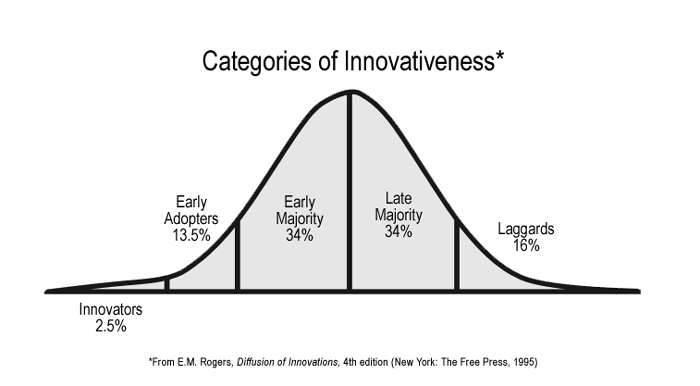
I think that social cohesiveness is not essential in reaching ubicomp but it certainly fastens the process. Adopting new technologies and trends has always been a curved line like this:
The cohesiveness can essentially fasten the processes of adopting and accepting new trends which leads to ubicomp.
Tuesday, October 5, 2010
Ethics and Law in New Media - Week 3
While reading the article, a sentence which caught my attention was this:
In the information age, we need to re-learn a lesson now a century old. Despite the sophistication of 21st century technology, today's e-mails are as open to the eyes of snoopers and intruders as were the first crude radio telegraph messages. Campbell (2000)In a situation, where the large part of peoples life goes on in the Internet, it is not comfortable to realize, that we are basically living under surveillance. Our every e-mail, blog post, web browsing history could be watched by someone. But as people are creating more and more online content, it must be getting hard for the system to grasp everything going on online. Therefore there probably aren't enough resource to keep an eye on every individuals actions in the Internet.
In the other hand, the system probably has prevented many crimes and maybe even wars. I imagine that knowing that this kind of system exists, should also discipline people, who are planning to commit some crimes or frauds. Therefore the system's existence is justified. As long as the system is in the hands of people, who's intentions are sincere and pro peace and balance, it should serve our best interests. But if somehow the system should fail or get into the hands of wrong people, a lot of damage could be done.
Write a blog description of an Internet fraud (scam) scheme.
Although there are much more complicated Internet frauds around today, I would like to talk about the most simple ones. The e-mails which I discover from my junk mail inbox couple of times a week. It says that either I have won some lottery or inherited a big sum of money and should send my personal data or even some kind of fee for them to send me the money. Of course, no heritage or lottery win actually comes from there.
I am surprised that people still fall for these schemes. Lately the scammers have learned to use the Google Translator, which makes these e-mails fun. The wrong grammar and major mistakes in sentences should convince the reader that the content can not be real.
Still a couple on times a year Estonian media together with the police or customer protection warn people about these kind of scams. It shows that there still are ignorant people out there who sincerely believe every e-mail they receive and get deceived. Maybe Internet education in schools schould help to prevent these situations from happening.
Review the scambaiting websites mentioned above. Analyse them from an ethical point of view.
The scambaiting websites are good examples of wild justice. There is an issue of ethics in every wild justice case. People who have been victims of a scam or just fed up with getting these scam e-mails have decided to step up. As the justice system is not working as effectively and fast as needed to punish the scammers, some people have taken the justice in their own hands.
I guess most people say that the scammers get what they deserve. Maybe that's why these kind of wild justice actions have not been banned for now. But where does it take us? Playing according to the same rules as criminals could make the player a criminal as well, doesn't it?
Probably the only acceptable solution would be to adjust the laws and justice systems in a way, that it would allow to punish these scammers and education systems should educate people about not falling for these kind of scams.
Sunday, September 19, 2010
Ethics and Law in New Media homework - Week 1
According to Theobald the term "mindquake" is formed as a parallel to "earthquake". He used the term describing a large and catastrophic shift in thinking. Theobald figured that it is better to learn all the time be open to new things and make small shifts in thinking instead of one large life changing shift.
While thinking about a real-life cases about mindquake, the first thing that comes to mind is the mindquake soon to happen in Estonia in 2011. From January 1st Estonia is going to change its currency from Estonian kroon to Euro. This will probably cause a lot of confusion and misunderstandings. Everyone will have to start calculating their salaries and everyday costs in Euros. The mind has to settle with the transition and create new associations in order to understand the value of the new currency.
It can be said that Theobald is correct by saying that it is better to make little shifts in thinking over time. For example if people consciously already in advance calculated their costs to Euros, it would be a lot easier to make the transition. Some people probably have taken it into consideration and are dealing with Euros already, but for most of the people, it will still definitely be a mindquake.
Pick one of Handy's paradoxes, find a good real-life illustrative case and describe it
Paradox of Justice
Paradox of justice is one of the most intriguing and at the same time most delicate subjects in Estonia recently. The contradictions between the laws and the punishments are being questioned daily in Estonia. Stories about people, who have committed crimes, but are walking free, can be read from the papers every day. The justice system, which is supposed to protect the innocent and punish the guilty, cannot work as black and white as the public expects it. There are other laws, which demand strict bureaucracy and definite order of steps to be taken before the person who committed the crime will be claimed guilty. Even if the fact that he did it is obvious to everyone. Every aspect of the crime has to be correctly investigated and documented in order to be accepted as a proof against the suspect in court.
Recently there was a case where a man, under the influence of the drug GHB killed two people by running them over with his car. He was drug tested afterwards, but as the clinic that tested him did not have a correct qualification to do the drug tests, the fact that he had used drugs could not be taken into consideration while he was trialed. Therefore he had a milder punishment. In one hand, the system is correct by stating that everyone should be treated the same. The rules must exist and everyone ought to stick by them. In the other hand, everyone knew about the fact that he had taken drugs, it had been medically proven, but there was nothing anyone could do about it.
Pick one of Castells' features of network society and write a short analysis
Changes in Work and Employment
Castell describes the features of Network Society. One of the relevant features in his opinion is the change in work an employment. As most of the work could be done online, there is no need for staying in the office from nine to five. The working time, place and regulations are flexible and allow the worker to manage his time himself.
This kind of work organization is becoming more and more popular. The emergence of wireless Internet and technology give a good possibility for the flexi-workers not to own an office at all. Basically one could manage a whole company from his living room or a cafeteria around the corner.
For an employer it is cheaper to buy in a service from a person who does not have to use the facilities, therefore does not need to have a desk, chair and a parking place. He does not have to be paid monthly or receive a huge compensation when being laid off.
This kind of work organization is comfortable for people who for example are not able to leave home for the whole day. Like mothers or fathers who have to take care of their babies at home or people who live too far away from their place of work, so it is more comfortable not to commute to work daily. This also gives an opportunity for physically disabled people to find work more easily, as the transportation issue is not a problem in this case.
In the other hand, working at home needs great time management skills. A flexi-worker has to establish a strict line between work and leisure time so that one would not interfere with the other. While working at home, it is at the same time possible to do too much work and get too little rest or the opposite, do not bother to do work in such a comfortable environment. As the computer is always open and notices of new e-mails pop up all day long, it is tempting to see who is writing and what is happening. It may lead to the fact that the family and leisure time could be forgotten. It just seems that there is so much work to do. But working from home could also be distracted by children running around, the dog wanting to go for a walk or a good show from TV. Therefore it is relevant to keep the working and leisure time apart to avoid burning out.