Sunday, October 10, 2010

Ethics and Law in New Media - Week 4

Investigate and describe an illustrative case of digital divide in your country


The digital divide is not a big issue in Estonia in my opinion and it is decreasing constantly. According to Esonian statistics up to 75% of people aged 16-74 year use Internet in Estonia. Although there is a difference between the usage of Internet in rural areas and cities, it is nothing dramatic. Basically anyone, who wants to get information from the web, gets it.

Another matter which may cause digital divide is the unwillingness of people to learn to use the computer. People who have not spent their time on learning how the internet, digital devices and computers work feel left behind and can not keep up with the pace. I can see this situation daily at work. I work for public sector.

People working for public sector in Estonia should be able to use the digital signature, different document administration systems, administrate web content etc but many of them haven't found time or will to learn these steps. The systems are developing fast and if they don't keep up with all the updates they are soon able not to do their work. Which leads to the fact that they will be set on side and new more computer-literate people take their places. It can be seen that some of them feel threatened and find excuses why they have not been able to learn the new systems, but the fact is that there is no point of escaping anymore.


Analyse and describe Internet availability in your country. How big is the availability difference for urban and rural regions? Do you consider this a problem?

According to Estonian statistics, Internet is available in 69% of the homes in cities and 65% of the homes in rural areas. Therefore it can be said that the difference is not very dramatic and I don't consider it as a problem. People who don't have Internet at home can use it at work or public Internet places.


Compare the current situation in Estonia to the four scenarios of "Estonia 2010". Which one is the closest to the reality?

Probably the closest to reality is the scenario of "South-Finland". Estonia has become a part of Europe and wants to distance from Russia. I would not be so pessimistic about low innovation capacity though. I think that the capacity is increasing and the potential is there if only it is used in the right way.


How important do you deem the social cohesiveness (or caring) in reaching ubicomp?

I think that social cohesiveness is not essential in reaching ubicomp but it certainly fastens the process. Adopting new technologies and trends has always been a curved line like this:
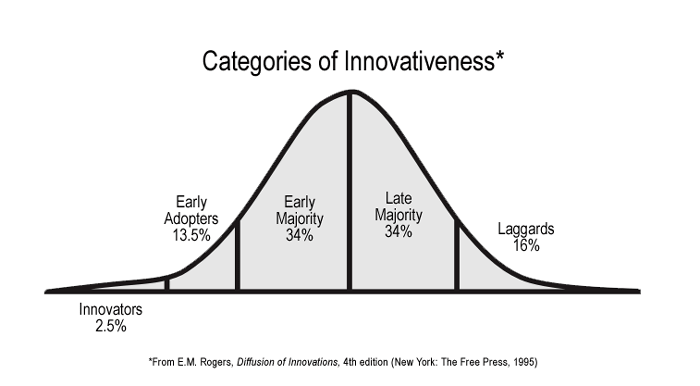


The cohesiveness can essentially fasten the processes of adopting and accepting new trends which leads to ubicomp.

Saturday, October 9, 2010

Locative technologies - Task 1


Description of an existing locative application

Live Tracker www.minurada.ee

Minu Rada is an application, which is used in sports competitions for tracking the competition in real time. Mostly for locating sailing yachts in open sea regattas. The tracking is carried out online. There are special positioning devices put on yachts, which send information to the map application after a certain period of time. This allows to track the event and related statistics in real time. The viewer can see a Google based map, where the routes of each yachts are marked. The map also consists of sea navigation marks. The table shows the rank, name of the boat, speed and distance. It is possible to watch the track of competition after the race. The tracker helps the athletes to analyze the process of the competition and look back at the most intriguing parts.


Positioning device


The main problem with this application is that the positioning devices work on batteries and therefore their working time is limited. In yachts, it is possible to load the batteries using the power source of the boat. But on long open sea regattas the teams want to reserve the boat batteries just in case if something happens, they do not want to load the positioning device and spend the battery power. Therefore these devices should have batteries which last longer of use some other power resource.

As the sailing race organizers started using this live tracker device during this summer, there are still a lot of improvements that needs to be done. The application could be made visually more attractive, design specialists should be involved. It also sometimes happens, that the application frozes, which could be annoying. Another addition I would suggest is that the terms like knots, seamarks and other should be explained for the application users. Maybe it would attract also people, who are not personally involved in sailing and are not familiar with the culture and terms. If the application is made more attractive, faster and user-friendly, it could be one of the best sources to introduce sports, which can not be easily tracked on spot, like regattas and long distance marathons, etc.

Friday, October 8, 2010

New Interactive Environments - Task 2

How did I plan my studies for Fall 2010?


While plannings my studies for this semester I considered four main aspects: the curriculum, available courses for this semester, my personal and work time schedule and my personal interests. When I found a compromise between all these aspects, I added the selected course blogs and web sites to my bookmarks and ordered RSS feeds where possible to my Gmail mailbox. IMKE Google calendar was a big help for getting an overview of the course timetable. Because of pretty big homework load I started using Remember the Milk for keeping up with all the assignments. My tasks in Remember the Milk are also connected to my mailbox. Basically all the necessary information is in Google calendar, bookmarks and mailbox.

Thursday, October 7, 2010

Introduction and Theoretical Foundations of New Media homework - Week 2


Concept map 2 - What is social interaction?
Essay question:
How does a community serve as a “cultural interface” to mediate communication with computers?

Manovich said that operations embedded in software are the general ways of working and thinking. I think that the ways of working and thinking are influenced by culture. A community usually shares a common culture or belief, therefore it can be said that it defines the way members of the community communicate with computers. In my opinion culture influences the ways we interpret the message, therefore culture also interprets the way we interact with computers, software, online environments and operations we use and create.

Tuesday, October 5, 2010

Ethics and Law in New Media - Week 3

Read the "Inside Echelon" by Duncan Campbell. Write a blog opinion about the present situation of the system, what it is used for and how it can influence the global community. You can also draw a couple of hypothetical scenarios (what if...).

While reading the article, a sentence which caught my attention was this:

In the information age, we need to re-learn a lesson now a century old. Despite the sophistication of 21st century technology, today's e-mails are as open to the eyes of snoopers and intruders as were the first crude radio telegraph messages. Campbell (2000)
In a situation, where the large part of peoples life goes on in the Internet, it is not comfortable to realize, that we are basically living under surveillance. Our every e-mail, blog post, web browsing history could be watched by someone. But as people are creating more and more online content, it must be getting hard for the system to grasp everything going on online. Therefore there probably aren't enough resource to keep an eye on every individuals actions in the Internet.

In the other hand, the system probably has prevented many crimes and maybe even wars. I imagine that knowing that this kind of system exists, should also discipline people, who are planning to commit some crimes or frauds. Therefore the system's existence is justified. As long as the system is in the hands of people, who's intentions are sincere and pro peace and balance, it should serve our best interests. But if somehow the system should fail or get into the hands of wrong people, a lot of damage could be done.


Write a blog description of an Internet fraud (scam) scheme.

Although there are much more complicated Internet frauds around today, I would like to talk about the most simple ones. The e-mails which I discover from my junk mail inbox couple of times a week. It says that either I have won some lottery or inherited a big sum of money and should send my personal data or even some kind of fee for them to send me the money. Of course, no heritage or lottery win actually comes from there.

I am surprised that people still fall for these schemes. Lately the scammers have learned to use the Google Translator, which makes these e-mails fun. The wrong grammar and major mistakes in sentences should convince the reader that the content can not be real.

Still a couple on times a year Estonian media together with the police or customer protection warn people about these kind of scams. It shows that there still are ignorant people out there who sincerely believe every e-mail they receive and get deceived. Maybe Internet education in schools schould help to prevent these situations from happening.


Review the scambaiting websites mentioned above. Analyse them from an ethical point of view.

The scambaiting websites are good examples of wild justice. There is an issue of ethics in every wild justice case. People who have been victims of a scam or just fed up with getting these scam e-mails have decided to step up. As the justice system is not working as effectively and fast as needed to punish the scammers, some people have taken the justice in their own hands.

I guess most people say that the scammers get what they deserve. Maybe that's why these kind of wild justice actions have not been banned for now. But where does it take us? Playing according to the same rules as criminals could make the player a criminal as well, doesn't it?

Probably the only acceptable solution would be to adjust the laws and justice systems in a way, that it would allow to punish these scammers and education systems should educate people about not falling for these kind of scams.

Monday, October 4, 2010

Locative Technologies - Lesson 1

Homework for Oct 11:
• Analysis of existing locative application
• Description: how it works. Who can use it. What tasks can you do with it.
• Technical data: which special programs, devices, server, frameworks, data flow does it need
• Possible problems: security, hardware, hard to understand
• Developing ideas. New user types, new roles, new solutions. Joining with other applications.

Saturday, October 2, 2010

Projektijuhtimine - 4.10.10

Vastused eelmises loengus esitatud küsimustele:
1. Leida näide ebaõnnestunud projektist ning selle projekti ebaõnnestumise põhjused.

Sotsiaalministeeriumi ebaõnnestunud IT-süsteemi ülemineku juhtum 2008. aasta lõpus.
Sotsiaalministeerium pidi üle minema uuele toetuse ja pensionite maksmise arvutisüsteemile, kuid ülemineku ajaks ei saanud süsteem päris töökorda ning selle tõttu jäi igakuisest toetusest kaheks kuuks ilma ligi 7000 töövõimetut inimest.
Projekti ebaõnnestumise põhjus oli ilmselt projekti juhtide ja ministeeriumi möödarääkimine ja tellija vähene asjasse pühendumine. Ministeeriumi huvi oli võimalikult kiiresti uuendus sisse viia, kuid ilmselt ei seletatud neile piisavalt tõsiseltvõetavalt, et süsteem ei ole valmis kasutamiseks. Lõpuks ei tahtnud keegi täielikult vastutust võtta.

2. Otsisõnade “project mandate”, “project brief”, “project charter” ja “project initiation document” abil tutvu veebis olevate projekti esialgsete kavadega.

Project Mandate - A business proposal is a written offer from a seller to a prospective buyer. Business proposals are often a key step in the complex sales process—i.e., whenever a buyer considers more than price in a purchase.
Project Brief - Statement that describes the purpose, cost, time performance requirements and constraints of a project
Project Charter - In project management, a project charter or project definition (sometimes called the terms of reference) is a statement of the scope, objectives and participants in a project.
Project Initiation Document - project initiation document is a logical document that brings together the key information needed to start the project on a sound basis. It should be conveyed to all stakeholders and agreed and signed off by the business sponsors.

Enhanced Computing Environment Project brief
http://www.ict.ox.ac.uk/team/ece_brief.pdf

Elimination of human trafficking from Moldova and Ukraine through labour market based measures
http://www.ilo.org/wcmsp5/groups/public/@ed_norm/@declaration/documents/publication/wcms_100457.pdf

Boosting Youth Employment – Development of Integrated Youth Employment Strategies for Azerbaijan and Kyrgyzstan
http://www.oit.org/wcmsp5/groups/public/---ed_protect/---protrav/---safework/documents/project/wcms_110499.pdf

3. Analüüsi loengukonspekti (http://www.tlu.ee/~pnormak/PJ-2009/konspekt-proj-juht-2009-29nov.pdf) lisas 2 olevat projekti esialgset kava. Millised aspektid võiks selles olla põhjalikumalt avatud?

Võibolla võiks esiteks rohkem lahti seletatud olla eelarve kujunemine, kuidas selline summa kokku saadi. Kuigi projekt on algfaasis, võiks kindlaid osalevaid organisatsioone siiski rohkem olla. Vastasel juhul tundub, et projektil ei ole piisavalt läbiviijaid või huvitatud osalejaid.